Resources

SAT prep resources and study planning articles

Study guides for SAT prep, SAT Math, practice tests, Reading and Writing, and parent support.

Student studying with books, notes, and a calculator

How to Build an SAT Study Plan

A strong SAT study plan starts with a baseline. Before guessing what to study, take a full practice test or review recent section scores so you know where time is being lost. The goal is to separate content gaps from timing issues, careless mistakes, and unfamiliar question types.

Once you know the starting point, set a realistic test date and break the work into weekly goals. A student might spend one week reviewing linear equations and grammar rules, then the next week applying those skills under timed conditions. The plan should include practice, review, and correction, not just more questions.

  • Start with a diagnostic or full practice test.
  • Pick 2-3 priority skills at a time.
  • Review every missed question and write down why it was missed.
  • Schedule practice tests far enough apart to actually learn between them.

The best plan is consistent but flexible. If a student improves quickly in one area, move on. If the same mistake keeps appearing, slow down and rebuild the concept before adding speed.

Ask about SAT prep


Students working on math problems with calculators and notebooks

SAT Math Topics Students Should Master

SAT Math rewards students who know the core topics deeply and can recognize them in different formats. Algebra is especially important: linear equations, systems, inequalities, functions, and interpreting graphs show up often. Students should be able to solve these cleanly and explain what each step means.

Advanced math also matters. Quadratics, exponents, radicals, polynomial expressions, and nonlinear functions can separate strong scores from excellent ones. Geometry, trigonometry, ratios, percentages, probability, and data analysis are also worth steady review.

  • Linear equations, systems, and inequalities
  • Functions, graph interpretation, and word problems
  • Quadratics, exponents, radicals, and polynomials
  • Geometry, right triangles, data analysis, and percentages

The key is not memorizing hundreds of tricks. Students should learn a reliable approach, practice recognizing the topic quickly, and review missed questions until the pattern becomes familiar.

Ask about SAT math
Student writing notes at a desk

How Often Should You Take Practice Tests?

Practice tests are useful because they show how a student performs under realistic conditions. But taking too many without reviewing them can waste time. The real improvement usually happens after the test, when students analyze missed questions and turn them into a study plan.

Early in prep, a practice test every few weeks may be enough. As the official test date gets closer, students may take them more often, especially if timing and endurance are major concerns. After each test, students should identify patterns: which topics were missed, which questions took too long, and which mistakes were avoidable.

  • Use the first test as a baseline.
  • Review mistakes before taking another test.
  • Increase frequency closer to the official SAT date.
  • Track timing, accuracy, and confidence by section.

A good rhythm balances full tests with focused practice. Full tests measure progress; targeted practice creates it.

Plan practice tests
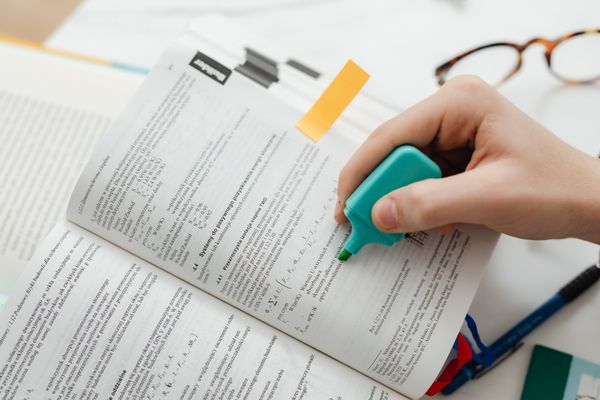
Student highlighting text in an open book

SAT Reading and Writing: Common Mistakes

Many Reading and Writing mistakes happen because students answer based on what sounds right instead of what the text proves. On evidence questions, the correct answer must be supported by the passage. If a choice feels reasonable but goes beyond the text, it is usually a trap.

Grammar questions require a different kind of precision. Students should know how to handle punctuation, subject-verb agreement, transitions, modifiers, and sentence boundaries. For transitions, the main task is to understand the relationship between ideas: contrast, cause, continuation, or example.

  • Choosing answers that are too broad or not directly supported
  • Ignoring punctuation rules and sentence structure
  • Misreading transition words and logical relationships
  • Rushing through short passages without identifying the main point

The best way to improve is to slow down during review. Students should ask, "What exactly in the text proves this answer?" or "What grammar rule is being tested here?"

Get reading support
Close-up of a student reviewing a workbook

How Parents Can Support SAT Prep

Parents can help most by creating structure without turning SAT prep into constant pressure. Students usually do better when they know what to work on each week, when practice is scheduled, and how progress will be measured.

It also helps to focus on process instead of only score. Ask whether the student completed practice, reviewed mistakes, improved timing, or understood a difficult concept more clearly. Those habits are what eventually lead to stronger performance.

  • Help protect regular study time.
  • Encourage review of mistakes, not just more practice.
  • Keep score goals realistic and tied to a timeline.
  • Support breaks, sleep, and school workload balance.

Good SAT prep should make students feel more organized and capable. Parents can support that by helping students stay consistent while giving them room to build ownership.

Start a plan
Student reviewing notes and practice test work at a desk

What to Do After an SAT Practice Test

The score is only the starting point. After a practice test, students should slow down and study the pattern behind the mistakes. Did they miss algebra because of content gaps, Reading and Writing because they rushed, or both sections because timing broke down near the end?

A useful review separates mistakes into categories: content, strategy, timing, and careless errors. Then the next week of prep should be built from those categories, not from random practice. If linear equations and transition questions caused the most trouble, those should become the next targets.

  • Mark every missed question with a reason, not just a correction.
  • Redo missed questions without looking at the answer first.
  • Group errors by topic and question type.
  • Turn the review into 2-3 specific goals for the next week.

Practice tests measure progress, but review creates progress. The students who improve fastest usually learn how to study their mistakes with honesty and a plan.

Review a practice test